How to Write a Warning Letter to an Employee (With Compliant Workplace Documentation Examples)
Employee warning letters help organizations document performance, attendance, and conduct issues while reducing legal risk. This guide explains how to create objective, compliant warnings, avoid retaliation claims, and use proven templates and documentation practices to support a fair and defensible disciplinary process.
For U.S. employers and small-business HR teams.
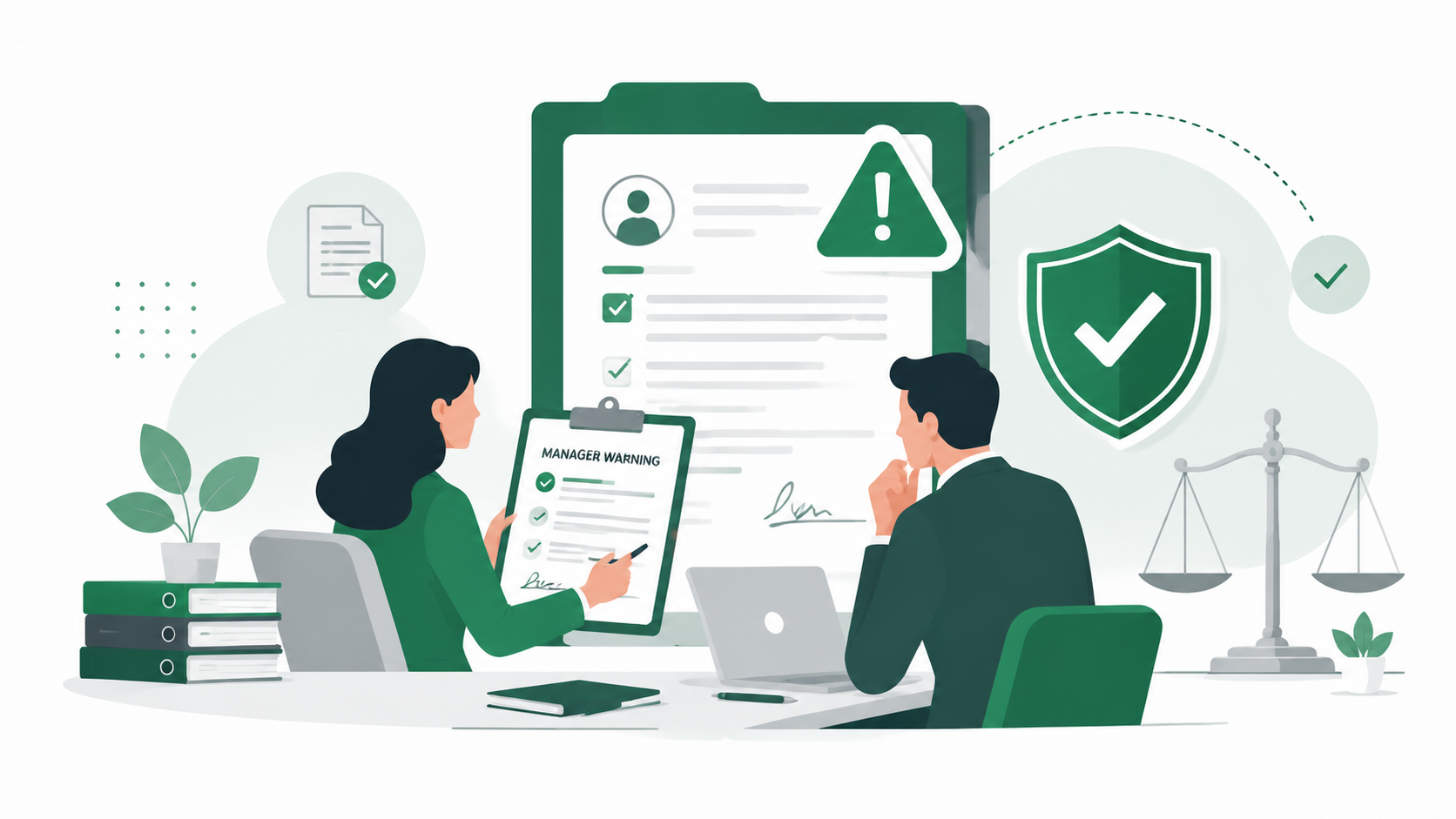
Drafting an employee warning letter, attendance memo, or notice? Run a free AI risk audit to detect subjective accusations, FMLA/ADA retaliation triggers, and legal pretext traps before delivery.
=============================================================================
SECTION 2: THE BLOG ARTICLE CONTENT (博文正文 - 英文)
=============================================================================
How to Write a Warning Letter to an Employee (With Compliant Workplace Documentation Examples)
Issuing formal discipline is one of the most critical actions an employer can take. When done correctly, it guides employees back to standard performance. When done poorly, it provides plaintiffs' attorneys with evidence of bias or pretext. Every supervisor must understand how to write warning letter to employee neutrally and objectively to avoid massive regulatory risks.
For human resource departments, establishing standardized templates and objective workplace documentation examples is the first line of defense against wrongful termination and retaliation claims under federal labor regulations.
The Vague Warning Trap: A Real HR Documentation Gotcha
Consider the experience of Sarah, the HR Director at a 100-person B2B services firm. A customer support representative, James, began submitting reports past deadlines. James's supervisor, frustrated by the delays, drafted a quick warning letter: "James, your productivity is extremely poor, and you are not being a team player. Your recent request to skip morning meetings because of medical treatments suggests you are checked out. Let's fix this attitude, or you will be fired."
James refused to sign the warning, claiming his medical requests were protected. A month later, James missed a critical client onboarding session, and the manager terminated his employment. James filed a wrongful termination and retaliation claim.
During the subsequent court proceedings, the attorney presented the warning letter. The judge ruled that the manager's written comments explicitly linking "productivity issues" to "medical requests" were direct evidence of retaliatory intent. The company had no defense and settled the claim. This disaster shows how a single subjective, unreviewed warning letter can compromise legitimate termination decisions.
💡 Self-Audit Tool: Before delivering any disciplinary memo, use our free Written Warning Compliance Scorecard to audit your draft against 12 statutory retaliation checkpoints in under 3 minutes.
⚖️ Real Federal Case Study: See how a manufacturing employer suffered a $450,000 jury verdict when a supervisor cited leave disruptions in a disciplinary notice in our Radiall USA FMLA Retaliation Case Analysis.
Why Proper Employee Warnings are Critical for Compliance
Written warnings establish a clear paper trail. Under federal laws like Title VII, the Americans with Disabilities Act (ADA), and the Family and Medical Leave Act (FMLA), courts use a burden-shifting framework. If an employee challenges an adverse action, the employer must provide a legitimate, non-retaliatory reason. A defensible paper trail of written warnings is the most reliable way to prove the action was based on objective metrics.
Key Elements of a Legally Defensible Warning Letter
To ensure your disciplinary documentation stands up to scrutiny by the Equal Employment Opportunity Commission (EEOC), every warning letter must contain these elements:
Objective Facts: Specific dates, times, and measurable errors, avoiding emotional adjectives.
Policy Citations: Reference the specific company handbook policy that was violated.
Prior Discussions: Reference the dates of any previous verbal coaching or caution letters.
Expectations & Consequences: Define clear target metrics, a timeline for improvement, and the consequences of failing to meet the standards.
Workplace Documentation Examples: Bad Wording vs. Safe Alternatives
Review these three common discipline scenarios to understand how to transition from subjective to objective documentation.
Example 1: Addressing Poor Performance
❌ Risky Wording: "Your sales numbers are terrible since you returned from FMLA leave. You are not putting in the effort."
✅ Safe Alternative: "Your total sales volume for Q2 was $15,000, representing 50% of the adjusted quarterly quota of $30,000. We expect you to hit your targets within 30 days."
Why it matters: Attributing performance issues to an employee's effort after they return from leave suggests retaliatory bias. Keep the review focused on adjusted quotas and numbers.
Example 2: Documenting Attendance & Unexcused Absences
❌ Risky Wording: "Your chronic morning tardiness is lazy and makes it impossible to schedule morning stand-ups."
✅ Safe Alternative: "The attendance logs show arrivals occurred after 9:15 AM on five occasions between May 1 and May 10, violating company punctuality policy 4.C."
Why it matters: Labeling an employee "lazy" is a subjective judgment that can be used as evidence of harassment. Cite company policies and exact dates.
Example 3: Addressing Workplace Misconduct & Policy Violations
❌ Risky Wording: "You had an unprofessional attitude and were aggressive toward the project lead in the meeting."
✅ Safe Alternative: "On June 2, you raised your voice and interrupted the project lead twice during the status meeting, violating workplace conduct policy 2.A."
Why it matters: "Attitude" and "aggression" are subjective terms. Describe the exact behavior, such as raised voice or interruption, to maintain documentation objectivity.
[!TIP] Audit your warning letters for compliance risk.
Avoid subjective or emotional language in your formal documents. Run a free Retaliation Check scan to review your warning letters in under 60 seconds, ensuring full compliance with labor guidelines.
Standard Written Warning & Caution Letter Templates
Use these compliant templates when drafting employee discipline letters.
Formal Written Warning Template
[Company Letterhead]
[Date][Employee Name]
[Title]Subject: Written Warning for Performance/Conduct
Dear [Employee Name],
This letter serves as a formal Written Warning regarding your [Performance / Conduct], specifically concerning [briefly state the issue, e.g., missed deadlines / policy violations].
On [Date of verbal meeting], we met to discuss these concerns. Since that meeting, the following issues have occurred:
[Date]: [Objective facts / specific policy violation]
[Date]: [Objective facts / specific policy violation]
This conduct violates [Company Name] Policy [Policy Number/Name], which states: "[Insert policy text or summary]".
Effective immediately, you are expected to meet the following standards:
[Objective expectation 1, e.g., submit reports by 5:00 PM every Friday].
[Objective expectation 2, e.g., arrive for shifts by 9:00 AM].
We will review your progress weekly for the next 30 days. Failure to meet these standards will result in further disciplinary action, up to and including termination of employment.
Sincerely,
[Manager Name]
[Title]
Sample Caution Letter to Employee
A caution letter is typically used as a preliminary, less formal step before a written warning.
Subject: Letter of Caution: [Topic]
Dear [Employee Name],
We are writing to caution you regarding [brief topic, e.g., recent scheduling patterns]. Our records show you were late on [Dates], which impacts our core coverage.
This letter is a caution, not a formal written warning, and will be kept in your file for [Number] months. We value your contributions and want to ensure you have the support needed to meet company guidelines.
Sincerely,
[Manager Name]
Frequently Asked Questions
What is the difference between a caution letter and a warning letter?
A caution letter (or letter of education) is a preliminary document used to address minor concerns or policy misunderstandings informally. A written warning is a formal step in progressive discipline, stating that failure to improve will result in termination.
How should an employer deliver a written warning to an employee?
A written warning should be delivered in a private meeting with HR or another manager present as a witness. The manager should discuss the warning, invite the employee to sign it, and store the signed copy securely in their personnel file.
Can an employee dispute a warning letter in writing?
Yes. Employers should allow employees to submit a written rebuttal or dispute. This rebuttal should be stored alongside the warning letter in the employee's file to ensure a transparent, fair documentation trail.
Legal Disclaimer: This article is for informational purposes only and does not constitute formal legal advice. For specific compliance guidance on federal or state employment regulations, consult a qualified employment law attorney.
Share this article
Continue with related compliance resources
Use these scenarios and docs to connect this article to a practical HR review workflow.
Attendance Warning Template
Use attendance language that checks for leave and accommodation protections.
Employee Attendance Issues
Review attendance documentation examples for safer manager follow-up.
Can a Manager Say Attendance Is Affecting Team Morale?
Avoid morale-based phrasing when protected leave might apply.
Related articles

Put the guide into practice
Check manager wording before it becomes part of the record.
Scan warning letters, leave discussions, coaching notes, and accommodation messages before they are sent.