4 Workplace Coaching Examples for Managers (Without Retaliation Risk)
Subjective or frustrated language in manager coaching notes, especially when near an employee's protected activity, presents a substantial risk of retaliation claims and legal settlements for employers. HR teams must establish objective communication standards and provide clear coaching examples to managers, ensuring professional feedback that protects the company from regulatory scrutiny and costly disputes.
For U.S. employers and small-business HR teams.
Drafting an employee warning letter, attendance memo, or notice? Run a free AI risk audit to detect subjective accusations, FMLA/ADA retaliation triggers, and legal pretext traps before delivery.
Coaching employees is a vital part of helping them grow, improving performance, and building strong B2B teams. However, when managers write coaching notes or send feedback messages, they often use subjective or frustrated language. If these messages occur near protected activities, like requesting medical leave or raising safety concerns, those off-the-cuff remarks can easily create legal issues.
For HR departments, establishing objective workplace coaching examples is essential for training managers, protecting the company, and keeping employee communications professional and fair.
The Slack Thread Trap: A Real HR Cautionary Tale
Consider the experience of Sarah, the HR Director at a 120-person professional services firm. A senior engineering manager named Dave had a high-performing developer, Alex, who began arriving late and missing morning stand-up meetings. Unbeknownst to Dave, Alex had recently requested a temporary schedule accommodation from HR for a chronic health issue.
Instead of consulting HR, Dave decided to "coach" Alex directly. He sent a quick Slack message:
"Alex, your schedule unpredictability is making it hard for the team to count on you. We need team players who are fully present during core hours. Let's fix this attitude."
When Alex's performance on a major project delayed a release, Dave placed Alex on a formal Performance Improvement Plan (PIP), referencing "unreliable schedule and poor attitude." Alex immediately resigned and filed an ADA retaliation claim.
During the investigation by the Equal Employment Opportunity Commission (EEOC), Dave's informal Slack message was introduced as primary evidence. The investigator determined that because the manager explicitly linked Alex's protected schedule accommodation to "poor attitude" and "unreliability," the PIP was likely a pretext for retaliation. The company was forced to reach an expensive settlement, all because of a single, unreviewed message.
This story shows how informal coaching, when poorly written, can compromise even legitimate performance management efforts.
[!TIP]
Is your manager communication compliance-approved?
Before sending a coaching note or warning draft to an employee, ensure your wording doesn't create exposure. Run a free Retaliation Check scan to review your text in under 60 seconds, or browse our interactive employee coaching examples scenario tool for quick reference.
Why Wording Matters: The Legal Risks of Informal Coaching
Many managers believe that because "coaching" is informal and not a written warning, the law does not apply. In reality, any written record—including emails, Slack threads, text messages, and handwritten notebooks—can be subpoenaed during a dispute.
The EEOC Retaliation Standard
Under federal labor laws like Title VII, the ADA, and the FMLA, employers are strictly prohibited from taking adverse action against employees for engaging in protected activities. The EEOC notes that retaliation remains the most common charge filed with the agency. A manager's coaching note that expresses frustration about accommodations, leaves, or complaints is often viewed as direct proof of a retaliatory motive.
Pretext: How Off-the-Cuff Remarks Become Court Evidence
When an employee challenges a disciplinary action, the court uses a burden-shifting framework. Once the employee shows they engaged in protected activity and suffered an adverse action, the employer must provide a legitimate, non-discriminatory reason for the action.
If the employee's attorney can point to coaching notes where a manager complained about "reliability" or "absences" near the time of the protected activity, they can argue the employer's stated reason is a "pretext" (a cover-up) for discrimination.
4 Workplace Coaching Examples: Bad Wording vs. Safe Alternatives
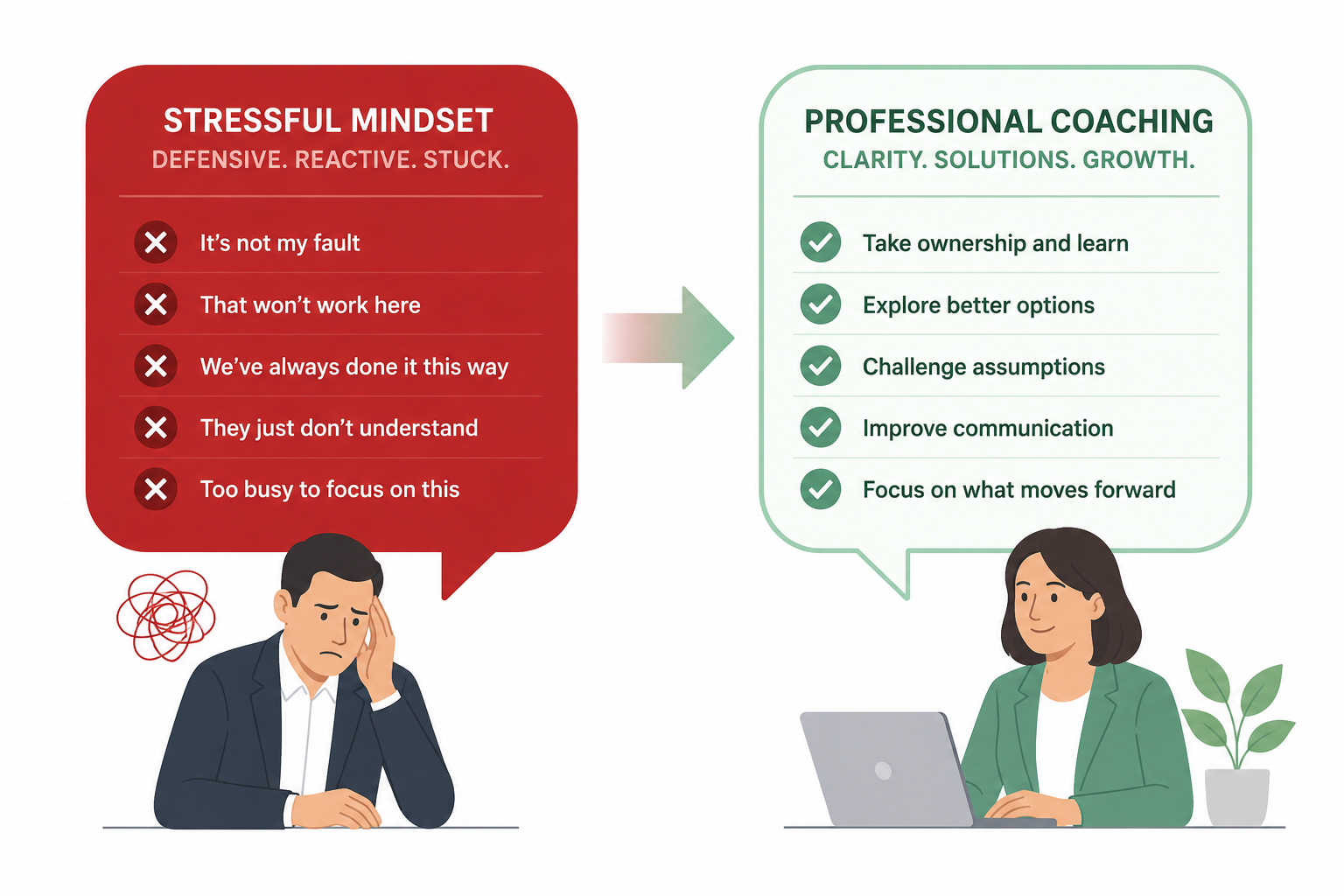
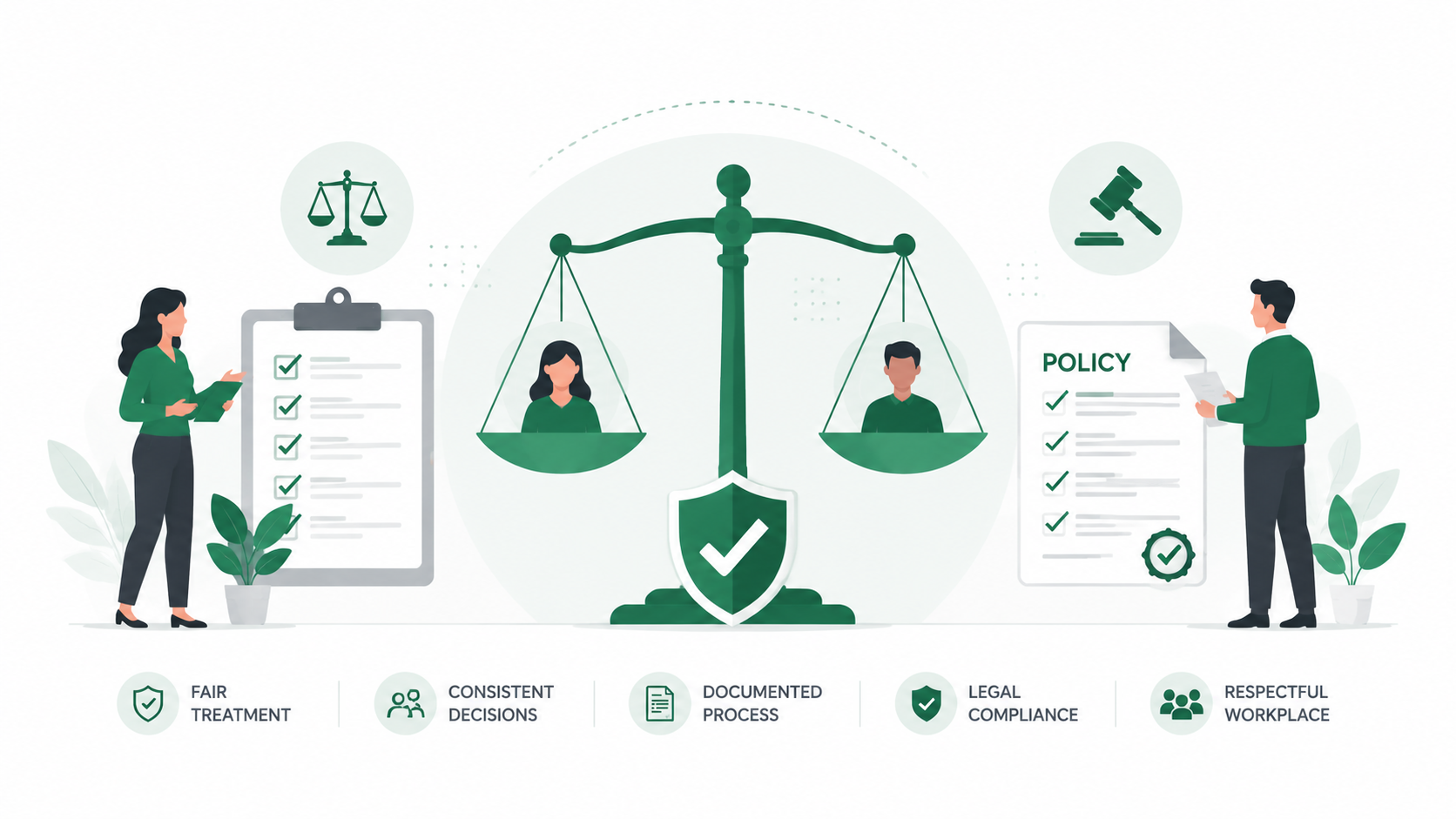
To help managers write objective notes and protect the organization, review these four common scenarios contrasting risky wording with compliant alternatives.
Scenario 1: Addressing Punctuality and Attendance Gaps
❌ Risky Wording (Frustrated & Subjective): "You need to be more reliable and stop letting your health issues affect your morning start times. Your lateness is hurting team morale."
✅ Compliant Wording (Policy-Based): "We need to review shift start times and operational coverage expectations. Let's coordinate with HR to determine if any leave or accommodation process applies to your schedule."
Why it matters: Referencing health issues or labeling an employee "unreliable" because of attendance creates FMLA or ADA interference risks. Keep the focus on operational needs and direct them to HR.
Scenario 2: Addressing Missed Deadlines and Performance Slips
❌ Risky Wording (Personalized & Aggressive): "Your work quality has dropped significantly since you complained about the workload last month. You seem checked out."
✅ Compliant Wording (Objective & Measurable): "We observed that the project deliverables due on May 15 and May 22 were submitted past the target deadlines. Let's discuss any specific obstacles and define clear project milestones for next week."
Why it matters: Linking performance slips to a complaint creates direct retaliation risk. Focus instead on dates, times, and measurable expectations.
Scenario 3: Correcting Attitude and Collaboration Issues
❌ Risky Wording (Subjective Labels): "Your attitude during the team sync was defensive and unprofessional. You need to accept feedback without arguing."
✅ Compliant Wording (Behavioral Observations): "During yesterday's team sync, you interrupted the project lead twice and walked out of the room before the meeting concluded. We expect team members to listen to peer feedback and remain for the duration of the meeting."
Why it matters: "Attitude" and "professionalism" are highly subjective terms that can hide underlying bias. Describe the exact behavior, its impact, and the policy expectation.
Scenario 4: Suspected FMLA or Sick Leave Misuse
❌ Risky Wording (Accusatory & Hostile): "It looks like you are timing your medical flare-ups to get long weekends. This pattern is unacceptable."
✅ Compliant Wording (Process-Oriented): "We observed a pattern of weekend-adjacent absences. We will review the company's attendance policy and coordinate with HR to confirm if any medical certification or leave tracking process is required."
Why it matters: Accusing an employee of abusing leave without proof can trigger interference lawsuits. Always follow standard HR processes and document the pattern objectively.
Best Practices for Documenting Workplace Coaching
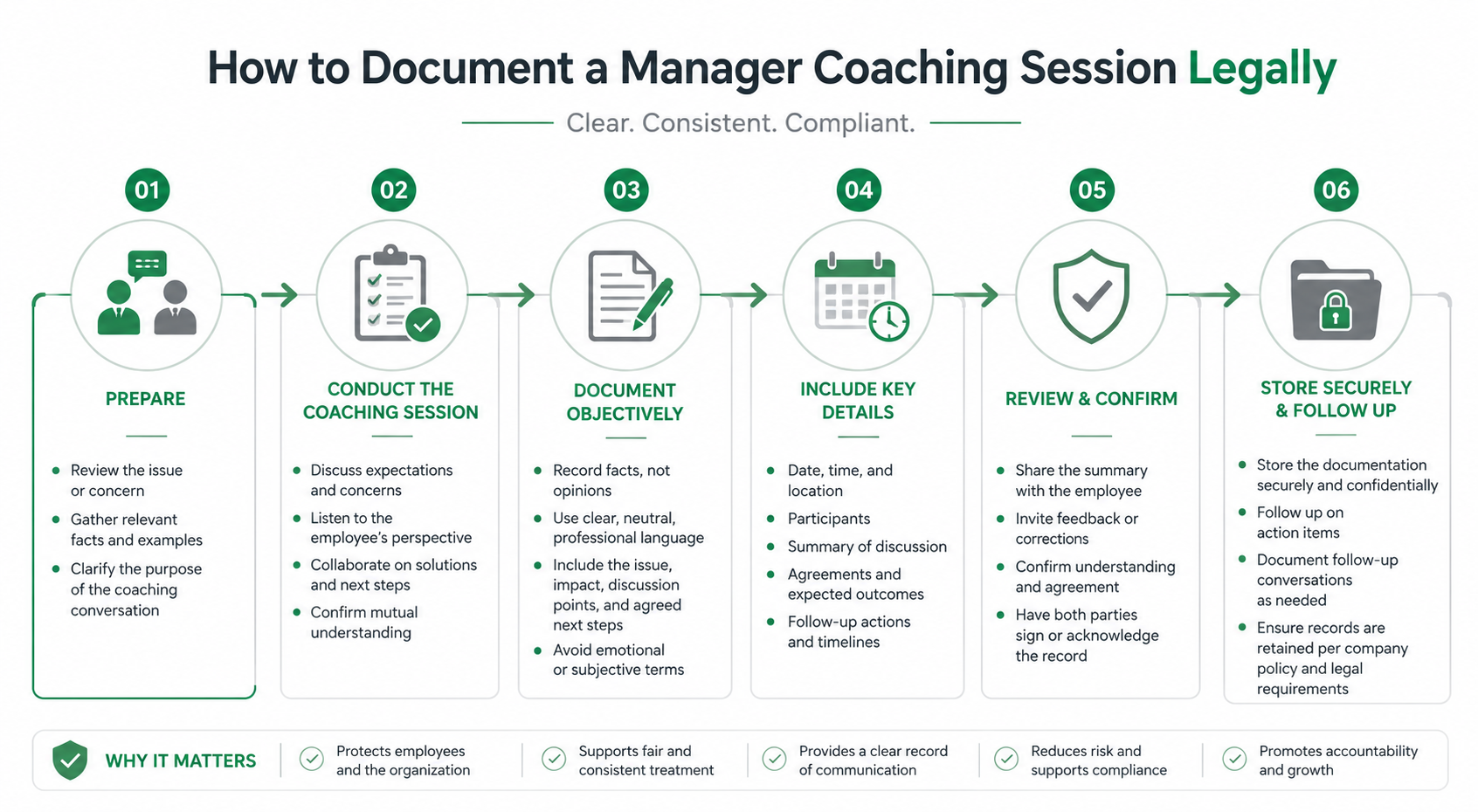
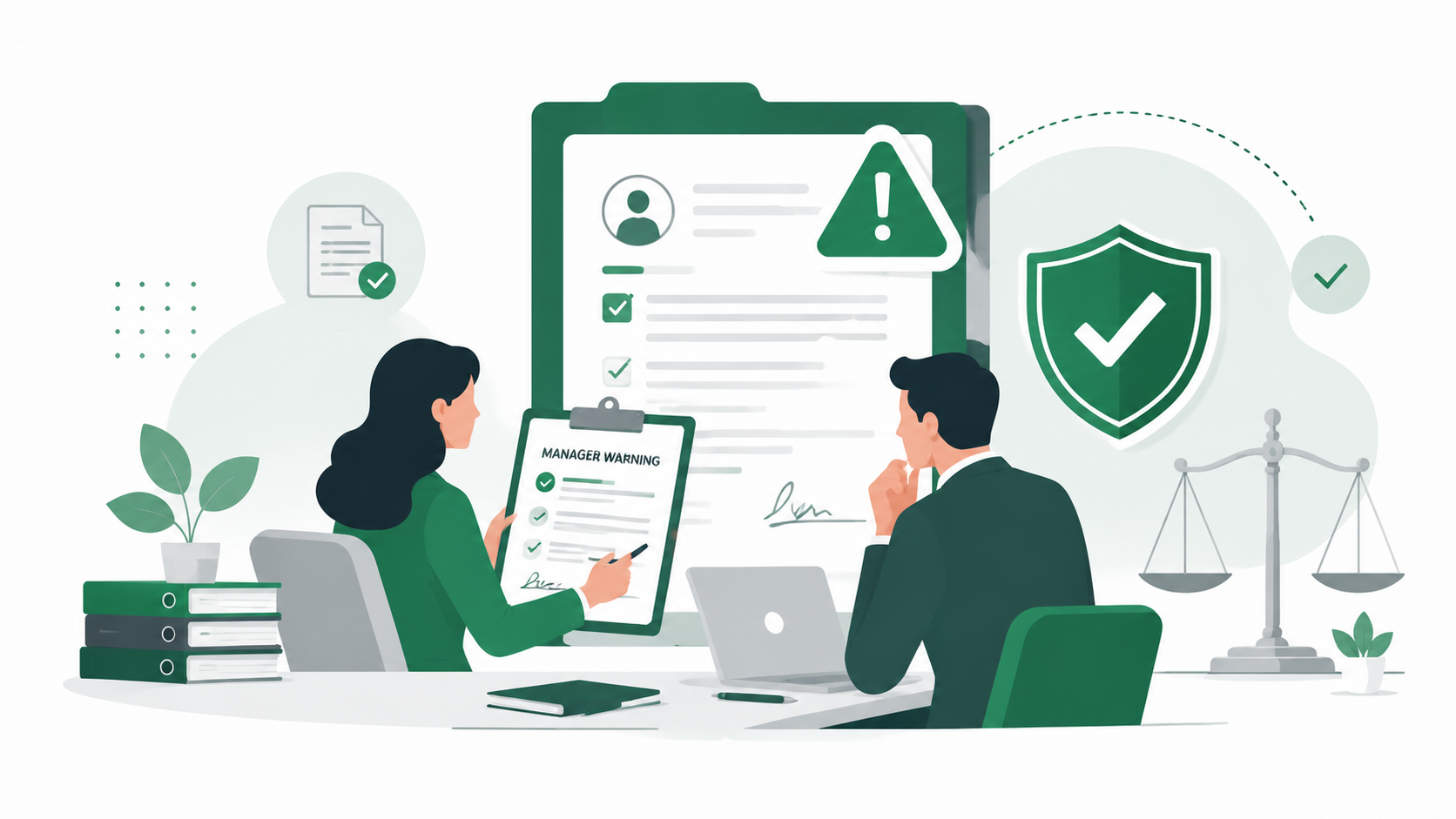
To ensure manager feedback supports employee growth while minimizing liability, establish a structured documentation process across your organization.
Prepare
Conduct the Coaching Session
Document Objectively
Include Key Details
Review & Confirm
Store Securely & Follow Up
1. Prepare
Before starting a coaching conversation, review the specific issue or concern. Gather relevant facts, dates, and examples of the behavior, and clarify the core purpose of the coaching conversation to keep it constructive.
2. Conduct the Coaching Session
Discuss expectations and concerns openly with the employee. Listen to their perspective, collaborate on actionable solutions and next steps, and confirm mutual understanding of the expectations before concluding the meeting.
3. Document Objectively
Record facts, not personal opinions or emotions. Use clear, neutral, professional language. Focus on documenting the issue, the impact, key discussion points, and the agreed-upon next steps while avoiding subjective or emotional terms.
4. Include Key Details
Ensure the coaching record contains essential details: the date, time, location, participants, a summary of the discussion, specific agreements, expected outcomes, follow-up actions, and clear timelines.
5. Review & Confirm
Share the written summary with the employee to invite feedback or corrections. Confirm mutual understanding and agreement on the documented points, and have both parties sign or acknowledge the record.
6. Store Securely & Follow Up
Store the documentation securely and confidentially in your HR system. Follow up on the agreed action items, document subsequent follow-up conversations as needed, and ensure records are retained according to company policy and legal requirements.
Frequently Asked Questions
What is the difference between coaching and disciplinary action?
Coaching is an informal, collaborative process designed to guide performance and clarify expectations. Disciplinary action (such as written warnings, suspensions, or PIPs) is a formal administrative process used when coaching fails to correct behavior. However, both forms of communication are legally discoverable in court.
Can a verbal coaching note be used as evidence of retaliation?
Yes. If a manager writes a recap email of a verbal coaching session (often called a "coaching note") and includes biased, frustrated, or retaliatory remarks, that email is direct evidence that can support a retaliation claim.
How long should an employer keep employee coaching records?
While federal record-keeping requirements vary under the Fair Labor Standards Act (FLSA) and EEOC rules, we at Retaliation Check recommend keeping all performance and coaching documentation for at least three years following an employee's termination to protect against potential wage, discrimination, or retaliation claims.
Legal Disclaimer: This article is for informational purposes only and does not constitute formal legal advice. For specific compliance guidance on federal or state employment regulations, consult a qualified employment law attorney.
Share this article
Continue with related compliance resources
Use these scenarios and docs to connect this article to a practical HR review workflow.
Employee Write-Up Examples
Draft factual warning language without protected-status references.
Employee Warning Letter
Structure warnings around conduct, dates, expectations, and next steps.
Termination Wording Examples
Review termination wording before it creates retaliation exposure.
Related articles
Put the guide into practice
Check manager wording before it becomes part of the record.
Scan warning letters, leave discussions, coaching notes, and accommodation messages before they are sent.