What is a RIF Letter? How to Write a Reduction in Force Notice Without Retaliation Risk
Poorly worded Reduction in Force (RIF) notices and subjective selection criteria significantly elevate legal risks, often leading to discrimination and retaliation claims under federal labor laws. Employers must ensure RIF planning, employee selection, and communication adhere to strict legal standards, avoiding any appearance of penalizing protected activities like FMLA leave or ADA accommodations to prevent costly regulatory liability.
For U.S. employers and small-business HR teams.

What is a RIF Letter? How to Write a Reduction in Force Notice Without Retaliation Risk
A Reduction in Force (RIF) is one of the most challenging events an organization can face. Beyond the operational disruption, executing a restructure introduces substantial legal risk. If an employer distributes a poorly worded reduction in force notice or selects candidates using subjective criteria, it often triggers expensive discrimination and retaliation claims under federal labor laws.
For business leaders and HR departments, writing a defensible RIF notice requires objective planning, adherence to strict legal standards, and clean, non-retaliatory communication.
The Legacy Spreadsheet Pitfall: A Real HR Layoff Disaster
Consider the case of Marcus, the sole HR manager at an 80-person manufacturing company in Ohio. During a market downturn, the executives ordered Marcus to coordinate a 15% headcount reduction. Marcus gathered performance data using custom spreadsheets, manually compiling ratings, attendance, and tenure.
Unbeknownst to the executive team, one of the supervisors had selected a production worker, Linda, for termination. Linda had recently taken intermittent FMLA leave for cancer treatments and returned with an ADA accommodation restricting heavy lifting. Because Marcus’s spreadsheet lacked automated updates, the selection column simply listed Linda's attendance rating as "poor" and noted her inability to perform forklift operations as a "productivity bottleneck."
When Linda received her RIF notice, she immediately consulted a lawyer. The subsequent audit by the Equal Employment Opportunity Commission (EEOC) revealed that the company relied on subjective attendance records that penalized protected leave. Because the spreadsheet directly cited Linda's lifting accommodation as a performance deficiency, the RIF was deemed a pretext for disability discrimination. The company settled for over $100,000, illustrating how manual tracking and subjective selections create regulatory liability.
What is a RIF Letter & RIF Letter Meaning?
A RIF letter, or Reduction in Force notice, is a formal document issued by an employer notifying an employee that their position is being permanently eliminated due to business reorganization, budgetary constraints, or corporate restructuring.
Unlike a typical termination for cause, which focuses on individual performance gaps or misconduct, the rif letter meaning centers on the permanent elimination of the role itself. The position is deleted, and the company does not intend to backfill the vacancy.
Avoiding Retaliation Risks in Reduction in Force Notices

When planning a corporate restructuring, human resource teams must evaluate how federal regulations govern selection decisions. Courts look closely at the timing of layoffs relative to protected activities.
FMLA Interference and Retaliation Claims
Under the Family and Medical Leave Act (FMLA), employers cannot use an employee’s protected leave as a negative factor in employment decisions. If you select an employee for a RIF shortly after they request leave, the close timing creates an assumption of retaliation. To defeat a lawsuit, the employer must prove that the position would have been eliminated regardless of the employee's FMLA status.
ADA Reasonable Accommodations During Restructuring
The Americans with Disabilities Act (ADA) protects qualified individuals with disabilities. During a RIF, managers often look for versatile employees who can handle multiple roles. However, selecting a disabled employee for layoff because their accommodation prevents them from taking on extra, non-essential duties constitutes discrimination. You must base selection criteria strictly on essential job functions.
[!TIP] Is your RIF documentation audit-proof?
Before distributing layoff notices, ensure your selection criteria and written text do not contain compliance risks. Run a free Retaliation Check scan to review your termination documents in under 60 seconds, or contact our support team to secure a compliance audit trail.
How to Write a Compliant Reduction in Force Notice
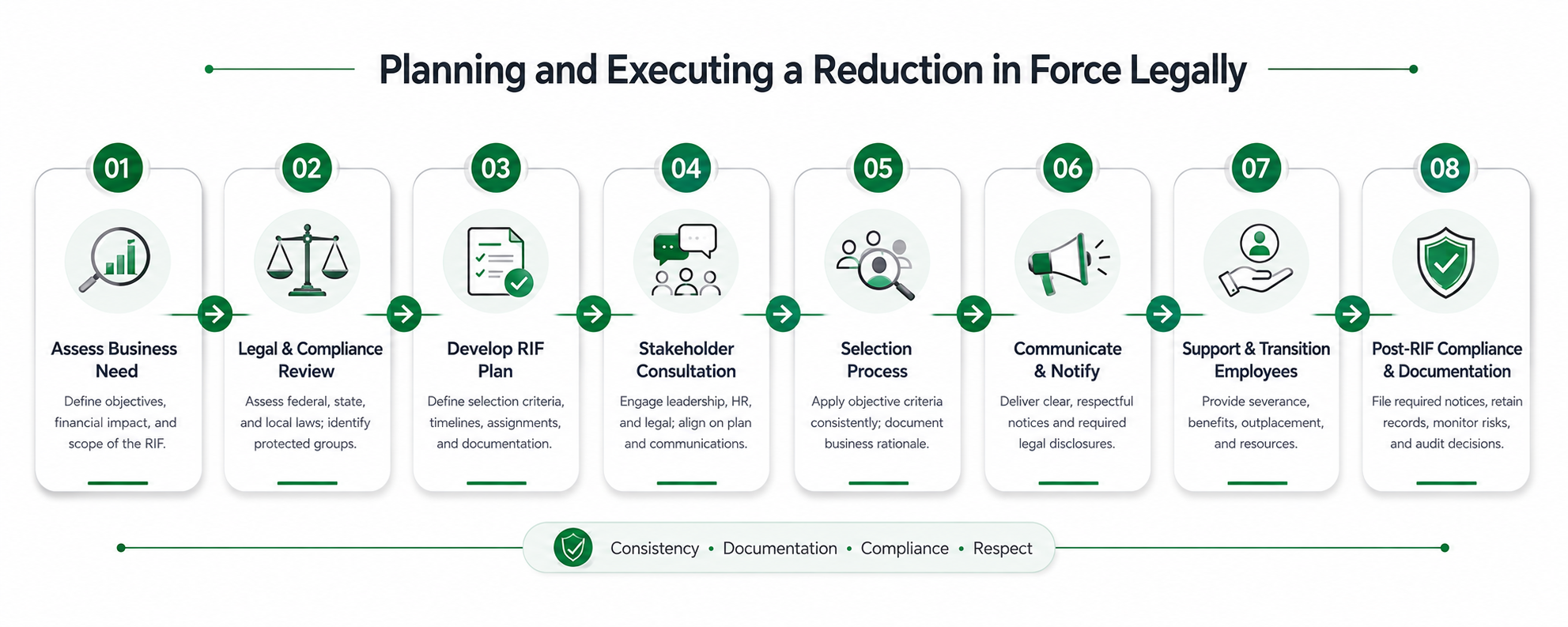
To protect your organization and maintain professional standards, follow this structured process when drafting a reduction in force notice.
Step 1: Document Objective Selection Criteria
Before writing any notices, establish a written selection matrix based on objective metrics. Acceptable metrics include:
Tenure or seniority (a standard, objective measure).
Documented historical performance ratings over a multi-year period.
Objective skills certifications and technical qualifications.
Avoid subjective ratings like "attitude," "cultural fit," or "flexibility," which plaintiffs' attorneys easily challenge as pretext for discrimination.
Step 2: Draft Clear, Non-Retaliatory Termination Language
The notice should be direct, professional, and entirely free of emotional or defensive language. State the business reason for the restructure clearly. Do not discuss individual performance shortcomings unless the RIF is structured around documented historical performance, and even then, frame the discussion around the elimination of the role.
Layoff Notice Template & Compliance Toolkit
Use this standard B2B template when drafting a reduction in force notice. Ensure all variables are customized to reflect your organization's specific business scenario.
[Company Letterhead]
[Date][Employee Name]
[Address]Subject: Notice of Position Elimination
Dear [Employee Name],
Please accept this letter as formal notification that your position as [Job Title] with [Company Name] is being eliminated as part of a company restructure due to [brief business reason, e.g., corporate restructuring / budgetary constraints]. This decision is permanent and is not a reflection of your individual performance.
Your termination will be effective on [Date]. On or before this date, you must return all company property, including keys, badges, and electronic devices.
[Detail severance package if applicable, e.g.: You are eligible to receive a severance package of [Number] weeks of pay in exchange for signing a standard release of claims. Details of this package and the release agreement are attached to this letter.]
We will provide you with information regarding your health insurance benefits under COBRA and the payout of any accrued, unused PTO in a separate package.
We appreciate the contributions you have made to [Company Name] during your tenure and wish you the best in your future endeavors.
Sincerely,
[Executive Name]
[Title]
[Company Name]
Frequently Asked Questions
What is the difference between a layoff and a RIF?
A layoff is typically a temporary separation from employment due to lack of work or economic conditions, with the expectation that the employee may be recalled when business improves. A RIF is a permanent elimination of positions due to restructuring or budget cuts, with no intention of refilling the roles.
Can an employee on active FMLA be laid off in a RIF?
Yes, but only if the employer can conclusively demonstrate that the employee would have been laid off even if they had not taken leave. This requires showing that the selection criteria were objective, documented, and applied consistently to all employees in the affected department.
What notice period is required under the WARN Act?
The Worker Adjustment and Retraining Notification (WARN) Act requires employers with 100 or more full-time employees to provide at least 60 calendar days' advance written notice of a plant closing or mass layoff.
Legal Disclaimer: This article is for informational purposes only and does not constitute formal legal advice. For specific compliance guidance on federal or state employment regulations, consult a qualified employment law attorney.
Share this article
Continue with related compliance resources
Use these scenarios and docs to connect this article to a practical HR review workflow.
What Not to Say to Employees on FMLA Leave
Compare risky FMLA leave wording against safer manager communication.
Can You Write Up an Employee on FMLA?
See how to document performance issues without tying discipline to protected leave.
FMLA Attendance Conversation Examples
Handle schedule and attendance discussions without implying interference.
Related articles


Put the guide into practice
Check manager wording before it becomes part of the record.
Scan warning letters, leave discussions, coaching notes, and accommodation messages before they are sent.